


"Can't you just hire someone to handle the business stuff?"
If you're a technical founder, you've probably said this—or at least thought it. After all, you can build the product. You understand the architecture. You can ship. Why do you need someone who can't even read your codebase taking up half the equity?
Here's the uncomfortable truth: technical excellence alone doesn't build successful companies. The graveyard of startups is filled with brilliant engineers who built technically superior products that nobody bought. The difference between a side project and a company often comes down to one thing: a non-technical co-founder who obsesses over the parts of the business you'd rather ignore.
What Does "Non-Technical Founder" Actually Mean?
Let's clear up a misconception. A non-technical founder isn't just "the person who can't code." That framing misses the point entirely.
A non-technical founder is someone whose primary expertise and focus lies outside of engineering. They might have backgrounds in:
- Sales and business development — opening doors, closing deals, building partnerships
- Marketing and growth — positioning, messaging, demand generation, brand building
- Operations — scaling processes, managing vendors, keeping the lights on
- Product management — customer research, roadmap prioritization, market strategy
- Finance — fundraising, financial modeling, unit economics, investor relations
The key word is complementary. A non-technical founder isn't less skilled than a technical one—they're differently skilled. And in the chaos of early-stage startups, that difference is what keeps the company alive.

Why Technical Founders Need a Counterpart
The Builder's Bias
Engineers love to build. It's what drew most of us to the field in the first place. There's something deeply satisfying about turning an idea into working software.
But this strength becomes a liability when building becomes an escape from the uncomfortable work of selling. It's easier to add another feature than to cold-call a prospect. It's more fun to refactor the codebase than to sit through a painful sales conversation where someone tells you why your product isn't quite right.
A non-technical co-founder doesn't have this escape hatch. Their job is the uncomfortable work. And having someone who can't retreat into the codebase forces the company to confront market realities.
Engineering Mindset vs. Market Mindset
Technical founders often approach problems with an engineering mindset: identify the optimal solution, build it correctly, ship it. This works great for code. It works terribly for markets.
Markets are messy. Customers are irrational. The "best" product doesn't always win. Sometimes the product that wins is the one with the best distribution, the most compelling story, or the founder who showed up to enough conferences.
Non-technical founders tend to think in terms of leverage, positioning, and relationships. They ask different questions: "Who can get us in front of the right customers?" "What story do we tell?" "How do we make this easy to buy?"
You need both mindsets. One without the other leaves you either with a product nobody knows about, or a pitch deck with nothing behind it.

Time Is the Constraint
Even if you could learn to sell, fundraise, hire, handle legal, manage operations, and build the product—when would you do it?
Early-stage startups are defined by constraints, and time is the most brutal one. Every hour you spend learning sales is an hour you're not shipping features. Every day you spend on investor calls is a day you're not fixing that critical bug.
A co-founder doesn't just bring skills—they bring bandwidth. They let you focus on what you're best at while someone equally invested handles everything else.

What Non-Technical Founders Actually Do
Let's get specific. In a typical early-stage startup, the non-technical founder might own:
Fundraising and Investor Relations
Writing the deck, building the pipeline, taking the meetings, negotiating terms, managing existing investors. This is a full-time job during active raises, and it's brutal for technical founders who'd rather be shipping.
Sales and Revenue
For B2B startups especially, someone needs to be on calls, running demos, following up on leads, and closing deals. This can easily be 40+ hours a week, and it requires a completely different skill set than engineering.
Hiring (Beyond Engineering)
Who's hiring the first marketing person? The first sales rep? The office manager? These roles require understanding what good looks like in domains where technical founders often have no pattern recognition.
Operations, Legal, and Finance
Incorporating the company, setting up payroll, negotiating contracts, managing cash flow, handling compliance. None of this is glamorous, all of it is necessary, and most of it is terrifying to delegate to a non-founder.
Customer Development
Yes, technical founders should talk to customers too. But non-technical co-founders often spend more time in customer conversations, synthesizing feedback, and translating market needs into product direction.
Brand and Positioning
How do you explain what you do? Why should anyone care? What's the narrative? Technical founders often struggle with this because they're too close to the technology. Non-technical founders bring the outside-in perspective.

The Investor Perspective
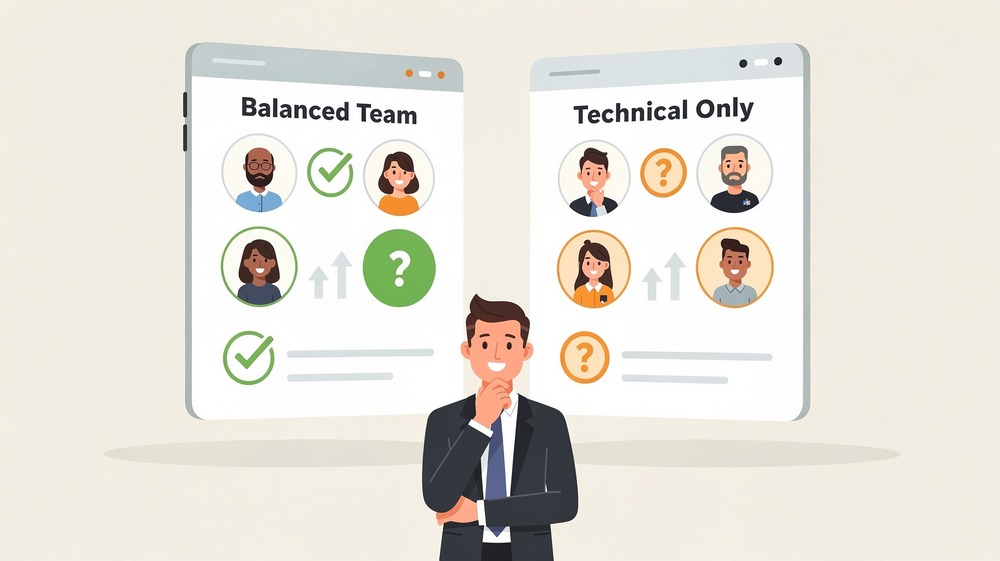
If you're planning to raise venture capital, here's something worth knowing: many investors explicitly prefer balanced founding teams.
Y Combinator's data consistently shows that teams with multiple founders outperform solo founders. Their research suggests that startups with two or three founders raise more money and are more likely to succeed than those with just one.
Investors look for "founder-market fit," but they also look for team completeness. When they see an all-technical founding team, red flags go up:
- Who's going to sell this?
- Who's talking to customers?
- What happens when you need to fundraise again?
- Can this team actually build a company, or just a product?
This doesn't mean you can't raise with an all-technical team—plenty have. But you'll face more skepticism, and you'll need to have good answers for these questions.
Common Mistakes and Misconceptions
"We'll Hire a Sales Team Later"
This is the most common mistake technical founders make. The logic seems sound: "Let's build the product first, get some traction, then hire salespeople."
The problem is that nobody sells your product as well as a founder. In the early days, you're not just selling a product—you're selling a vision, a roadmap, a relationship. You're asking customers to bet on you before you've proven anything.
Hired salespeople can scale what works. They can't figure out what works. That's a founder's job.
When you delay bringing in a business-focused co-founder, you're either forcing yourself to do work you're not suited for, or you're leaving critical company-building work undone. Neither is a good option.
"Technical Founders Can Learn Business"
This is true. Many technical founders have successfully learned sales, marketing, and fundraising.
But at what cost? Learning takes time, and time is your scarcest resource. Every month you spend getting decent at sales is a month a skilled co-founder could have spent getting results.
More importantly, there's a difference between "good enough" and "excellent." A technical founder can probably learn to be a passable salesperson. But is passable what you want for the function that determines whether your startup generates revenue?
Undervaluing the Contribution
Technical founders sometimes fall into the trap of thinking their contribution is more valuable because it's more tangible. "I built the whole product. What did you do? Talk to people?"
This mindset kills companies. If the non-technical co-founder wasn't having those conversations, who would be? If they weren't managing investors, negotiating contracts, and hiring the team, how would any of that get done?
The code is worthless without customers. The product is worthless without revenue. The company is worthless without the thousand operational details that keep it functioning.
Bringing Someone In Too Late
Another common pattern: waiting until the company is already struggling to find a business-focused co-founder.
By then, you're negotiating from a position of weakness. You're giving up significant equity for someone who's joining a company that's already underwater. And you've lost months or years of their potential contribution.
If you know you need a non-technical co-founder, start looking early—ideally before you even start building.
Finding the Right Non-Technical Co-Founder
Not just any business person will do. Here's what to look for:
Complementary Skills
This sounds obvious, but it's often ignored. If you're an introverted backend engineer, a co-founder who loves sales and can work a room is more valuable than another product person. Look for the skills you lack, not the ones you admire.
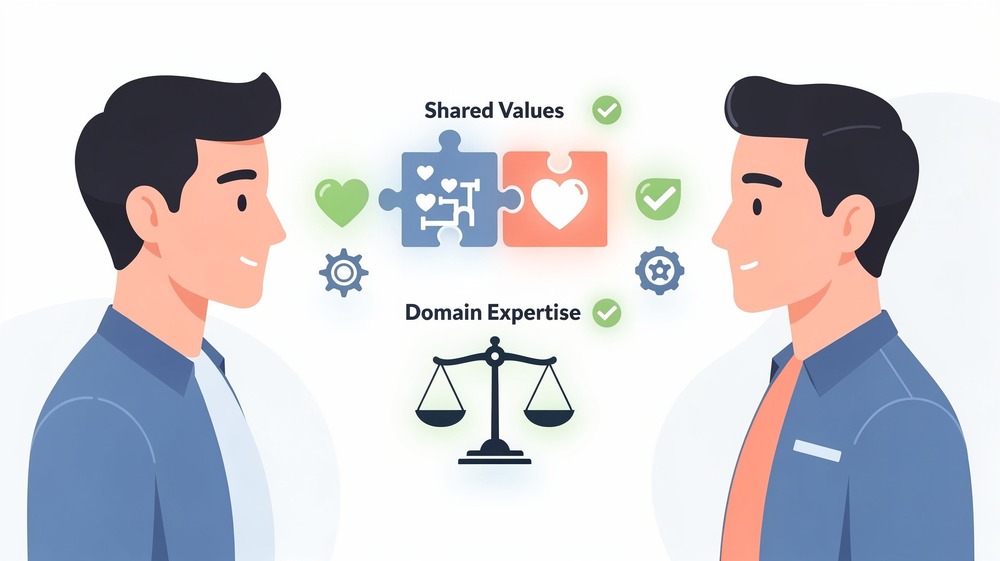
Shared Values and Work Ethic
You're going to spend years with this person, often in high-stress situations. Skill alignment matters less than value alignment. Do they work as hard as you? Do they care about the same things? Can you fight productively and move forward?
Domain Expertise
The best non-technical co-founders bring relevant industry knowledge. If you're building healthcare software, a co-founder who's worked in healthcare and understands the buyers is worth more than a generalist MBA.
Equity Alignment
Co-founder means co-founder. If you're bringing someone on with 5% equity while you keep 95%, they're not a co-founder—they're an early employee with a fancy title. Real co-founders have real ownership, which means real alignment.
When This Advice Doesn't Apply
Every rule has exceptions. Some businesses genuinely don't need a non-technical co-founder early on:
Developer tools and infrastructure: When your customers are developers, technical founders can often handle early sales because they speak the same language as buyers. The sales motion is more about product quality than relationship building.
Deep tech and research: If you're commercializing academic research or building something that requires years of R&D before it's sellable, a non-technical co-founder might just be waiting around.
Bootstrapped lifestyle businesses: If you're not trying to build a venture-scale company, you might not need the overhead of a co-founder. Solo founders can build successful small businesses.
Exceptional generalists: Some technical founders are genuine outliers who can do it all. They exist, but they're far rarer than most technical founders believe themselves to be.
The Bottom Line
Building a successful startup requires doing many different things well, simultaneously, under extreme time pressure. The odds that any one person excels at all of them are low.
A non-technical co-founder isn't a luxury or a concession to your weaknesses. They're a strategic asset that lets you focus on what you do best while someone equally invested handles everything else.
If you're a technical founder going it alone, take an honest look at your company. Who's doing the work that doesn't involve code? How well is it getting done? What's not getting done at all?
The best technical founders aren't the ones who can do everything themselves. They're the ones who recognize what they can't do—and find someone who can.
References
- Y Combinator: The Hardest Lessons for Startups to Learn
- Paul Graham, "The 18 Mistakes That Kill Startups"
- First Round Review, "What We Learned from 300 Startups"